




Until rThere are few things worse than the first blistering hot day of summer arriving, turning on your thermostat, and realizing your air conditioner isn’t up to the task.
Suddenly, your comfortable home feels like an oven, and you are faced with the dreaded homeowner question: Is this a quick, inexpensive fix, or do I need to buy a whole new system?
It’s a tough decision. You don’t want to sink money into a dying unit, but you also don’t want to replace a system that just needed a minor tune-up.
At OSS HVAC, we believe in helping our customers make informed decisions, not just making a sale. Here is a guide to the telltale signs that your AC needs professional attention, and how to distinguish between a repairable issue and the end of the road for your unit.
The “Wake-Up Calls”: Signs You Likely Need a Repair
These symptoms are annoying, but they often indicate issues that are fixable, especially if your unit is under 10 years old.
1. Blowing Warm or Weak Air
If the air coming out of your vents feels lukewarm, or if the airflow is barely a whisper, something is wrong.
- The likely culprits: This is often caused by a dirty air filter restricting flow, low refrigerant levels due to a leak, or a frozen evaporator coil.
- The verdict: Usually a Repair. These are common issues that a technician can diagnose and fix relatively quickly.
2. Strange Smells
Your AC should provide odorless air. If you smell something funky when the unit kicks on, take note.
- The likely culprits: A musty, mildew smell often means there is mold growth inside the ductwork or the unit itself due to excess moisture. A sharp, burning smell could indicate an electrical wiring issue.
- The verdict: Repair (and cleaning). Electrical smells require immediate professional attention to prevent fire hazards.
3. Unusual Noises
Air conditioners make noise, but you know what your unit usually sounds like.
- The likely culprits: Clanging or rattling often means a part has come loose. High-pitched squealing or grinding usually indicates a motor bearing issue or a slipped belt.
- The verdict: Repair. Don’t ignore these sounds; a loose part can eventually cause catastrophic damage to other components if left unchecked.
4. Short-Cycling (Turning On and Off Rapidly)
Does your AC turn on for five minutes, shut off, and then turn back on five minutes later? This is called short-cycling. It puts massive strain on the compressor and wastes energy.
- The likely culprits: It could be as simple as a faulty thermostat placement or as complex as an oversized AC unit.
- The verdict: Needs a professional diagnosis, but often a Repair.
The “Red Flags”: Signs It’s Time to Consider Replacement
Sometimes, throwing good money after bad is the wrong move. If you are seeing these signs, investing in a modern, energy-efficient replacement is often the smarter financial long-term strategy.
1. The Unit is Over 10–15 Years Old
Age is the number one factor. The average lifespan of a well-maintained central AC unit is about 15 years. Even if an old unit is technically still running, its internal components are worn out and operating inefficiently. If your unit is nearing its 15th birthday and faces a major issue, replacement is almost always the better option.
2. Your Energy Bills Are Skyrocketing
Have your cooling costs crept up significantly over the last few summers, even though you haven’t changed your usage habits? As AC units age, their efficiency rating (SEER) drops dramatically. A 15-year-old unit uses significantly more electricity to cool your home than a modern ENERGY STAR certified model. The savings on your monthly utility bill can sometimes offset a chunk of the cost of a new installation.
3. The “Money Pit” Effect (Frequent Repairs)
Did you call for a repair last summer? And the summer before that? If you find yourself on a first-name basis with your HVAC technician because they are at your house every few months, your system is a money pit. The cost of constant small repairs quickly adds up to a down payment on a new, reliable system with a warranty.
4. The Compressor Has Failed
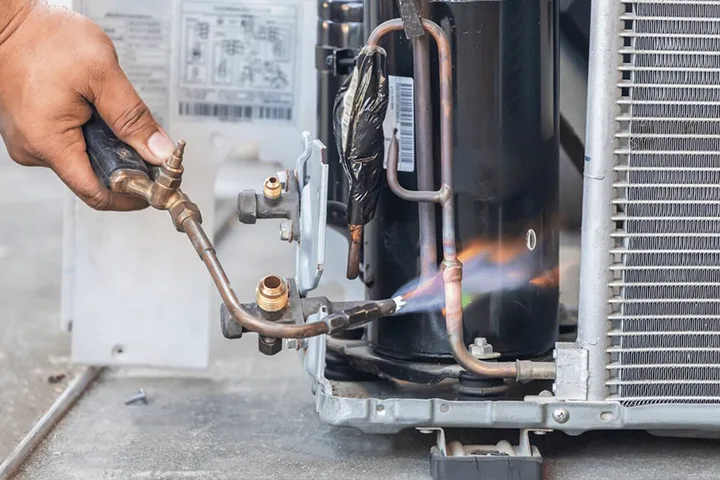
The compressor is the heart of your air conditioning system. If it fails, the entire system goes down. Replacing a compressor is incredibly labor-intensive and expensive. If your unit is out of warranty and the compressor dies, it is almost always more economical to replace the entire outdoor unit rather than pay for just the compressor replacement.
5. Your System Uses R-22 Freon
If your unit was built before 2010, it likely uses R-22 refrigerant (often called Freon). The EPA has phased out R-22 due to environmental concerns. As of 2020, it is no longer produced or imported. What this means for you: If your old unit develops a refrigerant leak, finding R-22 to refill it is becoming impossibly expensive and difficult. If an R-22 unit leaks, it’s time to upgrade.
The Decision Guide: The “50% Rule”
Still not sure? HVAC professionals often use the “50% Rule” as a general guideline for homeowners.
The Rule: If the cost of the necessary repair is 50% or more of the cost of a brand-new system, you should replace the unit instead of repairing it.
For example, if your 12-year-old AC needs a $2,500 compressor repair, and a new system costs $5,000, it makes far more financial sense to put that $2,500 toward the new unit rather than sinking it into an old dying one.
Need an Honest Assessment?
Don’t make this decision alone or under pressure. You need an expert to diagnose the root cause of the problem and give you the hard numbers on repair versus replacement costs.
At [Your Company Name], we pride ourselves on transparency. We will never pressure you into a replacement you don’t need, but we will also give you an honest assessment when a repair isn’t in your best financial interest.
Is your AC showing signs of struggle? Contact us today at [Your Phone Number] or [Link: Schedule an appointment online] for a professional diagnosis.
Leave a Reply